
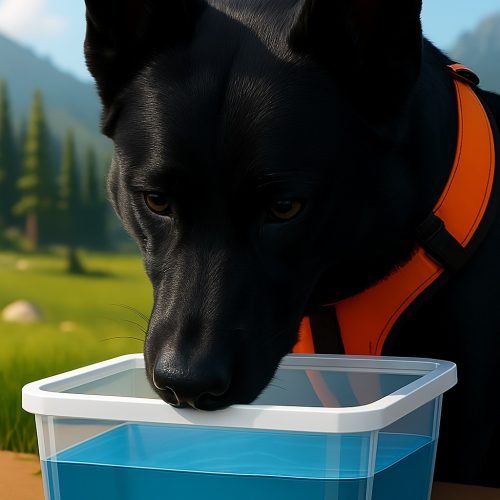
If your dog seems to hit a wall when it comes to buried searches in AKC Scent Work, you’re not alone! This element often has the lowest qualification rate – but why? Does your dog struggle with AKC buried searches more than any other scentwork/nosework elements? Even if your dog doesn’t personally struggle, do you ever wonder why the majority of teams find this element so uniquely challenging?
I believe there are four primary reasons why most teams struggle more with buried searches than any other element. Three of these reasons are deeply rooted in Scentwork Science.
Understanding Odor Molecules
Before diving into the specifics of buried search dynamics, let’s establish a foundational understanding: What exactly is odor?
Simply put, odor is your dog’s perception of airborne chemical compounds—commonly referred to as odor molecules—that have volatilized (evaporated into a gaseous state) and dispersed into the environment. These molecules escape from a scented source—like a half Q-tip prepared with essential oil—and begin to travel through the air.
When an AKC Scent Work judge prepares a hide, essential oil (a liquid) is applied to the cotton portion of the Q-tip. As the oil evaporates, it releases odor molecules into the surrounding air, creating a detectable cloud for your dog’s incredibly sensitive nose.
Now, consider the other elements involved in scentwork and nosework: Interiors, Exteriors, Containers, and—for UKC, USCSS, and NACSW—Vehicles. In these elements, the scented Q-tips are exposed directly to ambient air. This allows odor molecules to readily escape and form a plume.
But that’s precisely where buried searches differ dramatically. In these scenarios, the essential oil on the Q-tips is only briefly exposed to open air before being submerged beneath layers of sand or water. Before odor molecules can reach the ambient environment and be detected by your dog, they must overcome substantial environmental resistance:
- In sand, molecules must navigate microscopic air pockets and diffuse through a dense, granular medium.
- In water, they must first dissolve, then float or travel upward to the surface before volatilizing into the air.
In contrast, odor molecules in other search elements don’t face nearly the same level of difficulty becoming airborne and detectable.
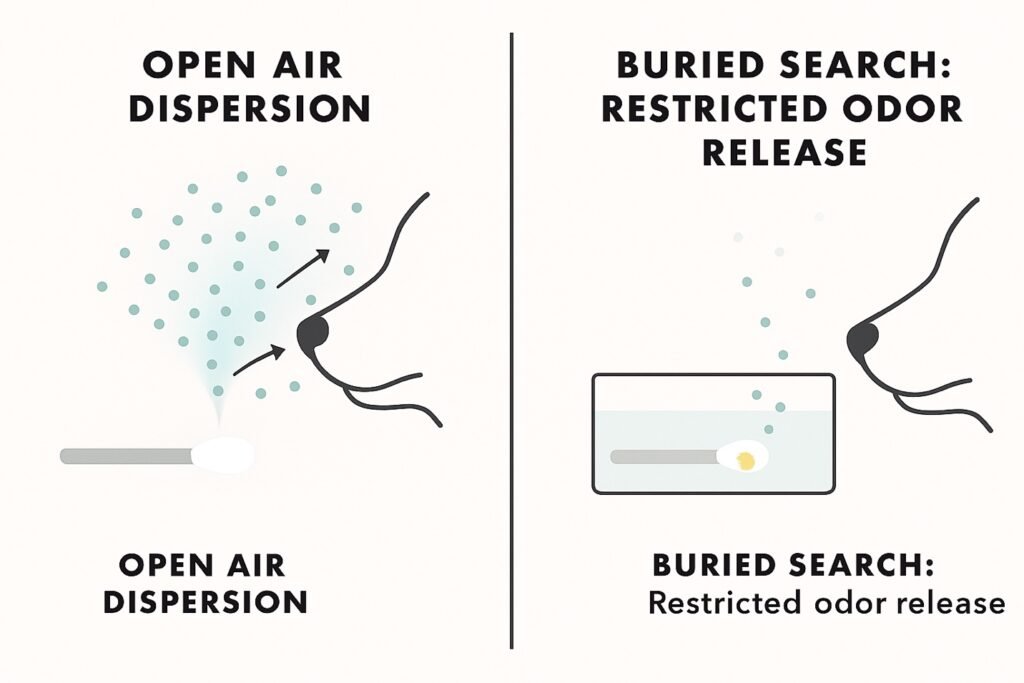
Odor Molecule Dispersion Comparison
This fundamental barrier is at the root of many unique challenges presented by buried search work.
The Four Crucial Reasons Buried Searches Are So Challenging
What makes buried searches such a tough test for both dogs and handlers? It comes down to four key challenges that make this element truly stand apart.
1. Odor Has to Work Hard to Escape
In elements like Interiors, Exteriors, Containers, or Vehicles, odor disperses directly into open air. But with buried searches, the hide is submerged in sand or water, which acts like a dense curtain. Odor molecules must fight their way through that barrier before they can even reach the dog’s nose.
Pizza Analogy: Imagine walking into a pizzeria and catching a fresh whiff of pizza straight from the oven. Now imagine that slice buried under four inches of sand or water inside a tote. That aroma has to push through the medium before you smell anything. Odor molecules in buried searches face the same struggle.
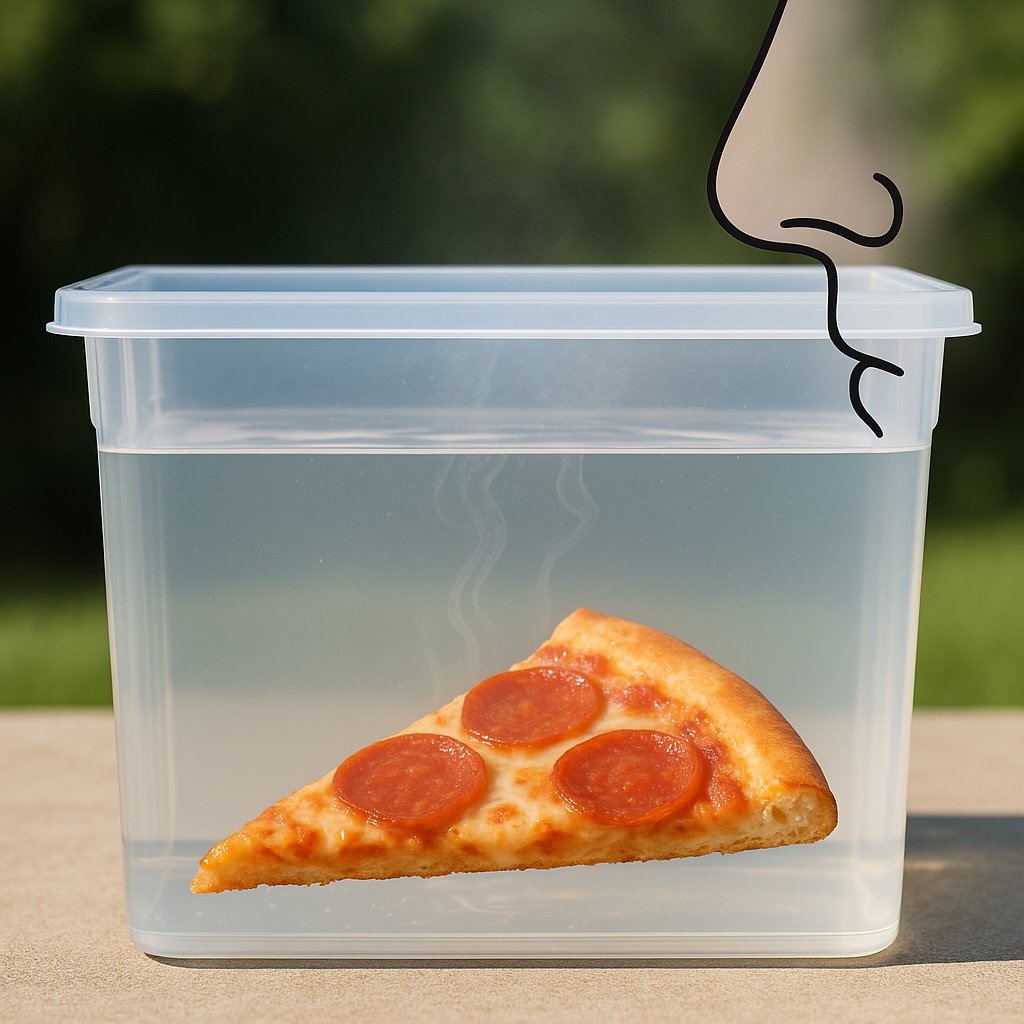
The Buried Pizza Analogy
2. Weakened and Wandering Scent Picture
Even when odor escapes the medium, it behaves erratically. In water, it dilutes and disperses. In sand, it slows and spreads thin. Dogs often work with hazy scent patterns, making it harder to pinpoint the source—especially with grates that keep them inches away from the actual hide.
Analogy Continued: Picture that buried pizza again—the aroma is faint, diluted, and drifting. That’s exactly what your dog deals with.
3. Temperature Changes Everything
Odor dynamics shift drastically based on environmental conditions. Warm sand or water helps odor molecules evaporate and rise. Cold temps, on the other hand, slow molecular activity and suppress odor release—making detection far more difficult.
Analogy Continued: A hot slice of pizza gives off strong scent; a cold one, not so much. Same principle applies here.
4. Buried Searches Require Serious Physical Effort
Unlike other elements that require minimal setup, buried searches demand literal heavy lifting. Totes must be filled, hauled, placed, and reset—often solo.
I didn’t just theorize this. I measured it!
- Each sand-filled tote: 26.7 lbs
- Each water-filled tote: 17.3 lbs
To simulate buried searches at each competition level:
| Search Level | # of Totes | Composition | Total Weight | Real-World Comparison |
| Novice Buried | 6 | All Sand | 160.2 lbs | Full-grown Great Dane 🐕 |
| Advanced Buried | 8 | All Water | 138.4 lbs | Large punching bag 💧 |
| Excellent Buried | 12 | 6 Sand / 6 Water | 264.0 lbs | Restaurant fridge 🧊 |
| Master Buried | 16 | 8 Sand / 8 Water | 352.0 lbs | Upright piano 🎹 |
These aren’t symbolic numbers—they’re real weights you haul. And they’re a big reason buried searches often get undertrained. The setup is grueling, and the time cost is steep. A Q-tip in a straw takes seconds. A master-level buried search? That’s a half-day workout.
The next time you’re at a trial, take a moment to appreciate the judges who often have to carry all this weight—often alone— (914.6 pounds) so our dogs can solve invisible mysteries and have a blast doing it.
The Solution: Train Smarter, Not Harder
Buried searches may be the most physically demanding and scientifically complex element in scentwork—but they’re also trainable. With the right setup, strategic progression, and handler awareness, you can turn buried from a blind spot into a strength.
Gear That Works (and Won’t Break Your Back)
Here’s the exact setup I use to simulate AKC buried searches efficiently and safely:
| Item | Purpose | Link |
| Sterilite 15 Qt ClearView Latch Boxes | Lightweight, stackable totes for sand/water hides | View on Amazon |
| Tebery Wire Cooking Racks (16″x10″) | Grates for odor access—fit perfectly on tote tops | View on Amazon |
| Pawfly Suction Cup Clips | Secure tubing or grates to tote edges | View on Amazon |
| JIH Black Airline Tubing (3/16″) | Simulate straw hides or direct odor channels | View on Amazon |
How to Move Mountains (or Just 300 lbs of Sand)
Efficient setup isn’t just about gear—it’s about getting it from point A to B without a hernia.
- Use Rolling Carts or Dollies: Like the one pictured, these can easily carry multiple loaded bins. Smooth surfaces and tight corners suddenly feel effortless.

Efficient Transport. A sturdy rolling cart makes moving heavy buried totes much easier
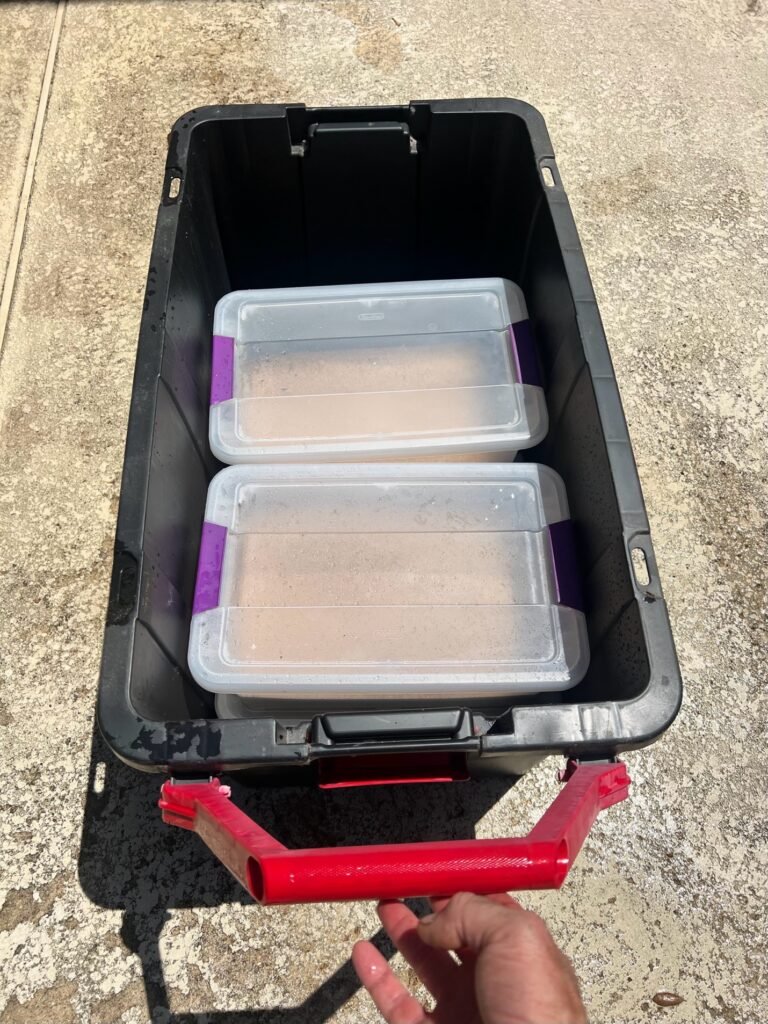
Ready to Roll. Two sand-filled totes inside a wheeled storage bin, easily dragged by one handler
- Wheeled Storage Tubs with Handles: These oversized bins aren’t just for containment—they’re mobile units. One handler can drag two fully loaded sand totes with minimal strain.
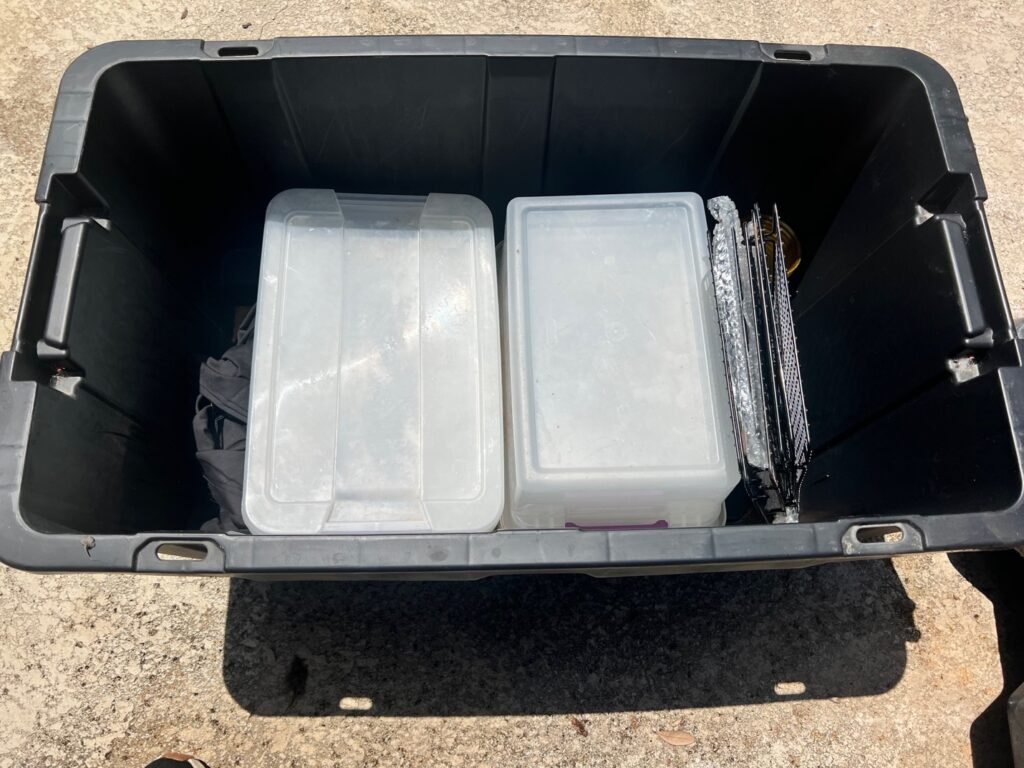
Compact Storage
- Stack & Nest for Efficiency: Your bins-within-bins setup lets you store training gear inside larger rolling containers. Minimal footprint, maximum control.
Training Tips That Actually Work
These aren’t just theories—they’re field-tested strategies that have helped my own dogs succeed:
- Train the Dog in Front of You No two dogs process odor the same way. High-drive dogs like Kaja often surge into search zones with urgency, occasionally bypassing subtle odor cues or fringe-alerting on neighboring totes. In contrast, Iliza brings a slow, methodical style—still developing precision but less likely to overrun source. Kaja struggled with buried searches early on until she learned to position her nose directly over the grates, where odor concentration peaks. Iliza, still young, hasn’t fully refined that skill, yet her deliberate pace gives her a solid chance to land near the odor source.
- Guide with Purposeful Leash Technique For dogs like Kaja, leash finesse helps calibrate speed and precision—a slight pause or redirect can refocus their nose back into productive zones. With dogs like Iliza, gentle leash cues can help center her nose directly over the grate, maximizing her detection potential. Every dog benefits from tailored handling—your leash isn’t just a tether, it’s a training tool.
- Start Small for Big Wins Smaller containers (like quart-sized bins) lighten the physical load and increase the number of productive reps. More reps mean more learning, especially for young or developing dogs.
- Factor in Temperature Variability Begin with cooler sand or water environments before introducing warmer conditions. This progression helps dogs build confidence across a range of scent profiles, prepping them for the variability they’ll face in real trials.
- Grate Mastery = Odor Mastery Odor concentrates at the grate. Training your dog to hover directly over it—whether through leash pressure, body positioning, or verbal cues—can dramatically improve source accuracy. Make grate targeting a foundational skill.
Final Thought
Buried searches aren’t just a test of your dog’s nose—they’re a test of your understanding, preparation, and adaptability. With the right tools and mindset, you can turn this element into a showcase of your team’s skill.
Don’t let buried searches be your team’s kryptonite. Implement these scientifically-backed and field-tested strategies to build confidence and precision. Reach out to us if you are interested in exploring training your dog for the specifics in AKC buried searches.
Share what you think in the comments!
2 Responses
Larry,
I LOVE the pizza analogy. Makes so much more sense.
With the AKC rule change effective October 2025, won’t that change the weights of sand? Now we just toss a cotton swab into the water instead of sticking it to the floor of the container. That must change things as well.
It will change the weight of sand. Technically speaking, or scientifically speaking, less sand means that odor doesn’t have to travel through so much “stuff” to be accessible to our dogs. The change for water, not having to include that suction cup and the qtip not having to be inside that tubing, should also make the odor more available to our dogs when searching.