
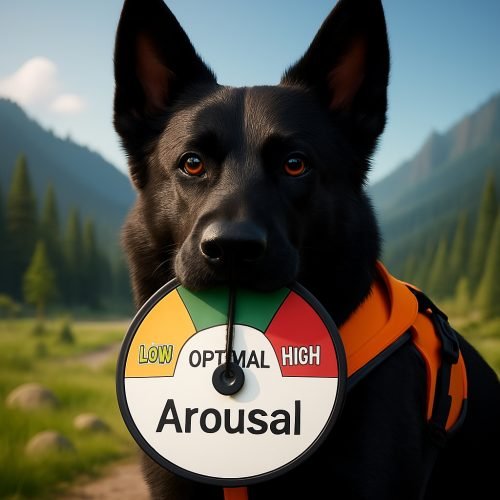
Imagine unlocking a hidden key to your dog’s most brilliant moments – a key that explains why they’re sometimes laser-focused and other times easily distracted or frantic. Every dog has an incredible capacity for engagement, but the secret to consistent excellence lies in understanding and managing an invisible force: arousal. In the world of scentwork, this translates to transforming casual sniffs into thrilling, precise detections that build confidence and deepen your bond like never before.
You know the magic moments in a scentwork trial: that exhilarating exterior search where your dog is perfectly “on,” nose glued to the ground, a blur of focused intention. But then, minutes later, you walk to the container line, and that same dog is casually glancing around, their previous focus and intensity seemingly gone. You wonder, “What happened? I did the same pre-search routine!” This stark contrast often boils down to a misunderstood factor: your dog’s arousal level. Every action you take—from your walk to the start line to your verbal cues—subtly, or dramatically, impacts that internal dial. Discover how mastering this delicate balance, finding that “Goldilocks Zone,” can unlock a consistent level of performance you only dreamed of.
This post dives deep into how understanding and managing your dog’s arousal, finding their optimal zone, directly impacts their performance and joy in scentwork. It’s about harnessing their natural drives for more consistent, accurate, and harmonious searches, and how the “Goldilocks Zone” can shift in different scentwork elements and how to fine-tune your approach for your unique scentwork partner.
What Fuels the Sniff? Decoding “Drives”
There are many types of drives associated with dogs, but we’ll focus specifically on three that are most relevant to the sport of scentwork. Understanding these drives helps handlers to harness a dog’s natural motivations rather than work against them.
First, let’s define what “drive” means in dogs:
Simple Definition for All
Think of “drive” as your dog’s inner motivation, their natural push or passion to engage in certain behaviors. It’s the intrinsic desire that makes them want to work.
Three of the most valuable drives in relation to scentwork are:
- Hunt Drive: The desire to search and locate hidden items, primarily using scent. This is the very heart of scentwork.
- Prey Drive: The desire to chase, capture, and possess. For a scent dog, finding the hidden odor is the ‘capture,’ leading to their reward.
- Food Drive: The powerful motivation to acquire and consume food. In training, this is a fantastic tool to build enthusiasm.
Assessing Drive in Dogs for Scentwork
Understanding your dog’s primary drives is key to motivating them effectively in scentwork. Here’s how a pet owner can start to assess their dog’s dominant drives:
Assessing Hunt Drive:
Observation: Does your dog enthusiastically investigate novel scents (e.g., a new smell on your shoes, where a squirrel was)? Do they use their nose actively to locate hidden toys or treats you’ve placed, rather than relying on sight? Are they persistent in searching, even when the item isn’t immediately visible? A strong hunt drive is seen in the dog that loves to find things, often with their nose to the ground.
Assessing Prey Drive:
Observation: How does your dog react to a moving object (e.g., a ball, a flirt pole, a piece of string)? Do they show intense focus, a desire to chase, and a strong urge to “capture” or possess the item once they get it? Do they readily engage in games of fetch or tug? While scentwork isn’t about chasing, this drive translates to the “capture” of odor and the reward at source.
Assessing Food Drive:
Observation: How excited does your dog get about food? Are they willing to perform simple tasks for even a small piece of kibble? Will they work for higher-value treats (chicken, cheese)? Do they meticulously search for dropped crumbs? A high food drive means food can be a powerful and readily available motivator in training.
By observing these natural inclinations, you can identify which drives are strongest in your dog, providing valuable insight into how best to motivate them for success in scentwork.
Summing it Up: Drive vs. Casual Sniffing
All dogs sniff – it’s how they explore their world. But there’s a significant difference between casual sniffing and the purposeful, persistent scenting required for formal scentwork. While a strong hunt, prey, or food drive can be a tremendous asset, it’s the management of these drives and their associated arousal levels that truly unlocks a dog’s potential for consistent success in this sport. While some breeds (like working line Malinois or German Shepherds) are often bred for and tend to exhibit very strong drives, it’s crucial to remember that every dog is an individual, and more important than the type of breed you have, it’s MOST important to “train the dog in front of you!” Every dog, regardless of their innate drive levels, can be guided to find their “Goldilocks Zone for brilliant scentwork.
The Emotional Dial: Understanding “Arousal”
Simple Definition for All
Arousal is your dog’s level of excitement or emotional intensity at any given moment. It’s their level of readiness, energy, and engagement for a task. It exists on a spectrum from low (sleepy, bored) to high (frantic, chaotic). Crucially, it’s not inherently “good” or “bad,” but finding the optimal level is key for performance.
Optimal Arousal: The “Sweet Spot”
This is the ideal state for both performance and learning. It’s the “just right” level of energy and focus. The dog is attentive, engaged, energized, and eager to work, but also calm, methodical, and thoughtful. They are acutely aware of their environment and receptive to information (including subtle scent cues).
In Scentwork, it Looks Like:
- Calm, Focused Nose: The dog is methodically working their nose, systematically covering the search area. Their sniffing is deep and consistent.
- Problem-Solving: They are able to work complex odor plumes, follow gradients, and discriminate between target and non-target odors.
- Precision: Alerts are clear, confident, and precise to source.
- Responsiveness: The dog is aware of their handler and able to respond to directional cues or encouragement without losing focus on the scent.
- Resilience: They can work through minor distractions.
Over-Arousal: The “Chaos Zone”
This is when a dog’s arousal level goes past their optimal point. They become too excited, too frantic, or too “amped up.”
In Scentwork, it Looks Like:
- Frantic, Speedy, Disorganized Searching: Running past hides, not slowing down to pinpoint, superficial sniffing, bouncing off walls or containers.
- Missed Hides: They literally run over or past the odor because they’re moving too fast or not sniffing methodically enough. They may not take the time to truly process the odor.
- False Alerts: Indicating on areas without odor due to impulsivity or misinterpreting environmental cues.
- Chaotic Indication: Frantic digging, excessive pawing, or otherwise disorganized alerts that lack precision.
- Ignoring Handler: Tunnel vision or being so “over the top” they don’t hear handler cues or redirection.
- Lack of Discrimination: Struggling to differentiate target odor from distractors or environmental odors.
Under-Arousal: The “Boredom Zone”
This is when the dog’s arousal level is disengaged, unmotivated, disinterested.
In Scentwork, it Looks Like:
- Slow, lackadaisical searching; easily distracted by environmental stimuli; frequent breaks; not engaging the nose fully; low drive to find the hide.
- Impact on Search Success/Learning: Leads to missed hides simply because the dog isn’t putting in the effort or attention. Learning is slow because there’s insufficient motivation or engagement with the task.
Frustration: How It Impacts Drive and Arousal
Frustration is a critical emotional state to understand in scentwork, as it directly impacts arousal and performance. It arises when a driven dog’s path to a goal (like finding odor or getting a reward) is blocked, delayed, or unclear. It’s a powerful emotional response to unfulfilled expectation.
- How Drive Fuels Frustration: High drive means higher stakes, thus stronger frustration when blocked. A highly food-driven dog, for example, will become more frustrated by a lack of access to food than a dog with low food drive.
- Frustration’s Impact on Arousal: Frustration almost always pushes a dog’s arousal level higher, but in a counterproductive way. It shifts them from a state of clear, cognitive focus to one of agitation, anxiety, or even manic behavior. This elevated, unproductive arousal makes it harder for them to think, problem-solve effectively, or maintain precision in a search.
- Recognizing Frustration: Look for behaviors like whining, barking, pawing, re-alerting excessively, offering unrelated behaviors (like heeling or sitting repeatedly when not cued), or even shutting down if they consistently feel ineffective.
Real-World Lessons: Finding the Goldilocks Zone
At SuperK9 Search, I’m lucky to work with my own high-drive Czech German Shepherds: Kaja, my seasoned 10-year-old veteran, and Iliza, my enthusiastic 18-month-old adolescent. They beautifully illustrate the nuances of arousal management and how the “Goldilocks Zone” is unique for every dog.
Kaja: The Masterclass in High Drive & Frustration Tolerance
Kaja is my ten-year-old seasoned scentwork veteran. While her experience and drive are immense assets, her natural intensity has also presented unique challenges in consistently finding her “Goldilocks Zone” for optimal performance.
Early Lessons: The “Bull in a China Shop”
Kaja is the epitome of a high-drive dog, naturally operating with a high arousal dial and a low tolerance for frustration. In our early scentwork days, before I fully understood the intricate dance between drive, arousal, and frustration, I often made handling mistakes that intensified these challenges.
I mistakenly thought “more excited equals better performance.” So, I’d try to really amp her up before a search. The result was often a “bull in a china shop” effect: her already naturally high drive and arousal would skyrocket, causing her to blast through searches. She was fast, yes, but wildly inefficient and too frantic to accurately process the scent picture. I learned that for Kaja, over-excitement was a detriment to precision.
The Challenge of Anticipation & Waiting
Beyond the search itself, managing Kaja’s arousal before a search also presented a significant hurdle. How familiar does this sound for those with experience at scentwork trials? You take your dog out of their crate to get in line, and then you wait, and wait. Kaja, with her intense drive, is incredibly eager to begin her search, and prolonged waiting is not something she tolerates well. Her behavior would escalate from subtle hints to full-blown attempts to “earn” a treat or make the wait end. She’d cycle through previously rewarded obedience behaviors: intently looking at me, pawing at my treat pocket, then perfectly heeling, then dropping into a down – all frantic attempts to problem-solve the situation and get to the action. This was a clear sign her arousal was climbing out of the “Goldilocks Zone” for focused work, even before we hit the start line. My solution for this specific challenge became to minimize her line-up time, ideally not removing her from her crate until she is very close to her turn to search.
Battling Boredom: When High Drive Leads to Under-Arousal
Interestingly, Kaja also presented challenges at the other end of the arousal spectrum, particularly in less complex scentwork searches like containers or buried hides. Here, her high drive wasn’t sufficiently challenged, often leading to under-arousal – a sense of boredom, a desire to get it over with, and even false alerts. For these elements, I learned I needed to bring her arousal up a little with my strategic enthusiasm (but not so much as to trigger her “bull in a china shop” mode or cause hard pawing/destruction). Crucially, managing her frustration in these scenarios meant ensuring instant reward delivery at source; any delay would quickly lead to escalation, such as excessive pawing for her indication.
Kaja’s Lasting Lesson: A Dynamic Goldilocks Zone
Kaja’s journey has truly been a masterclass in understanding that the “Goldilocks Zone” isn’t static. It demands constant reading of her current state and adjusting my handling – whether it’s dialing her down from anticipation, or gently dialing her up for simpler tasks, all while keeping her frustration tolerance in mind.
Iliza: The Sensitive, Motivated Adolescent:
Iliza is my vibrant 18-month-old Czech GSD who is Kaja’s niece. As an adolescent, her emotional regulation is still developing, making her arousal management a distinctly different challenge from Kaja’s. Her journey highlights how crucial it is to understand a dog’s developmental stage in shaping their arousal levels and frustration tolerance so that scentwork can be a joyful, memorable journey.
The Line-Up Challenge: From Amped to Absent
Iliza, also high-drive, presents a unique arousal pattern in scentwork. For her, getting in line too early at a trial can be counterproductive. She starts out excited and enthusiastic after leaving her crate, ready to work. However, if we have to wait too long, her arousal can swing too far the other way. She may begin sniffing around casually, overtly noticing other dogs walking by, and even if I try to get her focus, she might calm down too much, simply lying down. When it’s finally our turn, her arousal may have dropped so significantly that she struggles to engage fully, often becoming distracted early in the search.
Arousal Hijacked: The Battle Against Distraction
Due to her developing mental maturity, Iliza’s arousal is easily hijacked by environmental stimuli. Unlike Kaja, whose focus on odor is well-established, Iliza’s brain is still learning to filter background noise. This means her innate drive and arousal, instead of being channeled purely towards odor, become dispersed by novel sights, sounds, and smells. She can easily become overtly distracted, preventing her from achieving the consistent, focused arousal needed for efficient search work. This isn’t a lack of drive, but a challenge in directing that drive effectively amidst competition.
Competing Motivations: The Pull of Novelty
This developmental stage also means that novelty often presents a strong competing motivation, directly impacting her arousal and frustration. Her brain is still solidifying the concept that “odor equals jackpot.” When faced with an exciting new stimulus, her arousal can be instantly elevated towards that novelty, pulling her away from the scent task. This creates a moment where her drive for the novel item competes with her drive for odor, leading to an inconsistent reward economy and potentially frustration if the odor isn’t immediately as compelling as the distraction.
Frustration Tolerance: Mental Shutdown from Overwhelm
Iliza’s developing brain similarly affects her Frustration Tolerance. When search complexity escalates too quickly, it can overwhelm her processing capacity, leading to a unique manifestation of frustration: mental shutdown. Unlike Kaja, who might escalate with physical demands for reward, Iliza may simply disengage, appearing to “check out” if immediate success isn’t apparent. This isn’t a lack of desire, but a limited learned resilience to persist through difficulty without quick gratification, causing her to abandon the task.
My Energy: Her Guide to Focus
These behaviors demonstrate how my energy directly impacts her arousal and ability to engage. The challenge is providing just enough motivation to engage her in scentwork without tipping her into overwhelmed distraction or allowing her to “shut down” from over-exposure. This is a daily, ongoing lesson in reading her specific needs for optimal scentwork focus as her mental and emotional maturity develops, gradually building her capacity to filter distractions, prioritize odor, and persist through challenging searches.
The Handler’s Toolkit: Mastering Drives, Arousal, and Frustration for the Goldilocks Zone
We’ve explored the foundational elements of scentwork success: the inherent motivations of drives, the shifting emotional intensity of arousal, and the disruptive force of frustration. Now, it’s time to bring these concepts together into a powerful handler’s toolkit. Finding your dog’s optimal arousal zone – that “Goldilocks Zone” – isn’t a static achievement, but a dynamic skill that transforms your partnership and unlocks consistent brilliance in every search. It involves a continuous dance of observation and strategic adjustment.
The Art of Observation: Your Primary Diagnostic Tool
Before you can fine-tune anything, you must first truly see the dog in front of you. Your most potent strategy is becoming a keen observer, a nuanced reader of your dog’s internal state. Throughout a search, actively monitor for:
- Drive Manifestation: Is their inherent hunt, prey, or food drive clearly directed towards odor, or is it being pulled elsewhere? Are they showing the persistent, purposeful sniffing of high hunt drive?
- Arousal States: Are they optimally engaged and methodical? Are they becoming frantic and chaotic (over-arousal)? Or are they disengaged and disinterested (under-arousal)?
- Frustration Signals: Are you seeing the tell-tale signs like whining, barking, excessive pawing, offering unrelated behaviors (like heeling when not cued), or even shutting down? Remember, frustration directly impacts arousal, often pushing it higher in a counterproductive way.
The Individualized Approach: Listening to Your Dog
Every handler needs to truly understand their dog. Not based on generic advice, but on what they have found works. Your dog is constantly communicating what they need and how they are feeling; your role is to learn to “speak dog” so you can understand their communication. For instance, Kaja’s random behaviors while waiting in line are her telling you how she feels. If you ignore her, or don’t change your actions based on her behaviors, that would likely create even more frustration. What works to decrease or increase arousal for one dog might be ineffective or even counterproductive for another. While a calming routine might settle some over-aroused dogs, for others, like Kaja when she’s anticipating a search, forced obedience can actually increase frustration or kill drive. Your dog can tell you what works for them, but you have to be willing to explore and discover with them what truly helps them find their balance. Be willing to experiment, observe their feedback, and adapt your approach.
Strategy 1: Channeling Drives to Optimize Arousal
Understanding your dog’s primary drives isn’t just for assessment; it’s your blueprint for both elevating and tempering arousal to hit that sweet spot.
Fueling Engagement in Under-Aroused Dogs
For dogs lacking initial enthusiasm or becoming bored, strategically tap into their strongest drives.
- Throw a Party at the Source: Instead of just a single treat, provide a “party” of high-value treats and use your voice and excitement to celebrate their success like it’s the greatest thing ever. Most dogs inherently want to engage with us, and this overwhelming positive reinforcement powerfully taps into their desire to please and their drive for reward, making them eager to repeat the behavior.
- Strategic Warm-ups: A brief, exciting game of tug or chase (tapping into prey drive) just before a search can serve as a controlled energy boost, lifting their arousal from a disengaged state.
- Prompt & Precise Reward Delivery (Frustration Prevention in Under-Challenged Scenarios): For dogs who become bored or frustrated when tasks are too easy or rewards aren’t immediate (like Kaja in less complex searches), swift and accurate reward delivery at the source is crucial. This not only reinforces the find but actively prevents the escalation of frustration that arises from a perceived lack of success or challenge, which otherwise disrupts optimal arousal and focus.
Controlling Drive for Focus in Over-Aroused Dogs
For high-drive dogs whose excitement spills into chaos, managing their drive is key to bringing arousal down.
- Your Calm Presence: Maintain a calm, deliberate, and steady demeanor at the search area. Your own controlled energy is a powerful tool to help settle your dog and prevent their arousal from escalating further.
- Strategic Line Management (Preventing Pre-Search Escalation): Instead of waiting in long lines where frustration and over-arousal can build, keep your dog in their crate until closer to your turn. Just before your run, take them out for a potty break and engage in dog-specific calming or redirecting activities away from the immediate search area. For Kaja, this might mean a brief, engaging play session that channels her drive away from the impending search task. For a dog like Iliza, specific calming exercises might be more effective. The key is active engagement that prevents the build-up of frantic energy or frustration, rather than simply “waiting it out,” which only escalates the problem.
Strategy 2: Direct Arousal Adjustment & Frustration Management
Beyond channeling drives, direct intervention on arousal and active management of frustration are crucial for consistent performance.
- Environment Management: Carefully choose your training environments. Systematically expose your dog to a variety of environments (not just home or trial sites) that present different levels of stimuli. This builds their resilience to distractions and helps them learn to manage their arousal in novel settings. In a trial, continue to manage their exposure, focusing their attention on you until it’s time to approach the start line.
- Start Line Rituals: Implement specific rituals right at the start line to fine-tune arousal for the search ahead.
- For Over-Arousal: If your dog’s arousal is too high, implement a specific calming ritual. For a dog like Iliza, this involved placing her between my legs to help her focus on the search area, and not be distracted by all the things outside of the search area. I only release her to search once I see this mental re-engagement.
- For Under-Arousal: If your dog’s arousal is too low, implement some specific excitement rituals. Use your voice, gentle nudges, or a quick, focused burst of praise to get them excited and mentally “on” for the search.
- Prioritize Precision Over Speed: Actively reward for accurate, methodical alerts rather than frantic speed. This shifts your dog’s focus from rapid-fire, potentially chaotic searching to thoughtful, precise work, directly counteracting the “bull in a china shop” effect and promoting a more controlled arousal state.
- Consistent and Clear Expectations: Ambiguity is a major source of frustration. Ensure your scentwork tasks are well-understood, with clear rules and consistent criteria. This is especially vital for sensitive dogs like Iliza, who might mentally shut down when overwhelmed by complexity or a perceived lack of success, helping to keep their arousal productive rather than spiraling into defeat.
Mastering these strategies is an ongoing journey, a continuous conversation with your canine partner. By skillfully adjusting your approach based on their unique drives, current arousal state, and frustration threshold, you’ll empower them to consistently find their Goldilocks Zone, transforming every search into a joyful, precise, and rewarding experience for both of you.
Conclusion: The Unspoken Ribbon – A Partnership Defined by Understanding
In the thrilling world of scentwork, it’s easy to get caught up in the pursuit of ribbons, titles, and perfect hides. Yet, as we’ve explored the intricate dance of drives, arousal, and frustration, a deeper truth emerges: the most profound success lies not just in the “find,” but in the quality of the journey you share with your dog.
Understanding the nuanced interplay of drive, arousal, and frustration is paramount for unlocking your dog’s full potential in scentwork. It’s a dynamic journey of observation, empathy, and continuous adjustment, always centered on finding that perfect Goldilocks Zone for your individual dog on odor.
Remember, your dog is always communicating, and their ultimate experience in scentwork is a direct reflection of your ability to understand and respond to their unique emotional and energetic states. The “Goldilocks Zone” isn’t merely a performance metric; it’s a state of optimal comfort, engagement, and joy for your canine partner.
If a search doesn’t go as planned, that responsibility often rests on our shoulders as handlers. It’s about what we could have done differently with our handling, what strategies we could have implemented before or during the search to better manage our dog’s feelings. If our dogs false alerts on a hide, it’s not because they wanted to lie to us. This self-reflection and commitment to adaptation are, in themselves, a “medal-worthy experience” that truly strengthens your team.
For your dog, the ultimate “win” isn’t confined to a found hide. Did they better manage their barking before a search? Did they maintain focus despite distractions? Did they persist through a challenge without succumbing to overwhelming frustration? When your response as a handler shows them you were listening, that you helped them navigate their internal world and manage their drives, arousal, or frustration, they feel truly accomplished. They learn that even in perceived “failure,” you were a guiding presence, making the experience fun and exciting. This positive emotional takeaway is what truly motivates your dog for the next search. When they know that engaging in scentwork will lead to an experience where they feel seen, supported, and ultimately successful – regardless of the outcome on the results – they will eagerly choose to participate again and again. That connection, that feeling of mutual understanding and accomplishment, is the unspoken ribbon, the most valuable prize of all.
Whether you’re just dipping your toe into the exciting world of scentwork, navigating the nuances with an adolescent, or refining the performance of a seasoned pro, learning to read and respond to your individual dog’s arousal needs in search scenarios will transform your training, deepen your bond, and lead to more consistent, joyful results on the odor.
Ready to find your dog’s optimal arousal zone for brilliant scentwork performance? At SuperK9 Search, we specialize in helping you understand and work with the incredible dog you have, guiding you both to a successful and joyous scentwork partnership.