
Don’t Train HD Until Your Dog Is Solid On Foundational Odors, Right?
Handler Discrimination (HD) in AKC Scentwork and UKC Nosework is often considered an advanced, highly challenging discipline. Dogs can struggle with the nuances of human scent, leading to inconsistent alerts and handler frustration.
What if I told you that by focusing on one simple, often overlooked factor – the “stink” – you can unlock your dog’s HD potential from a surprisingly young age, even when others find it incredibly challenging?
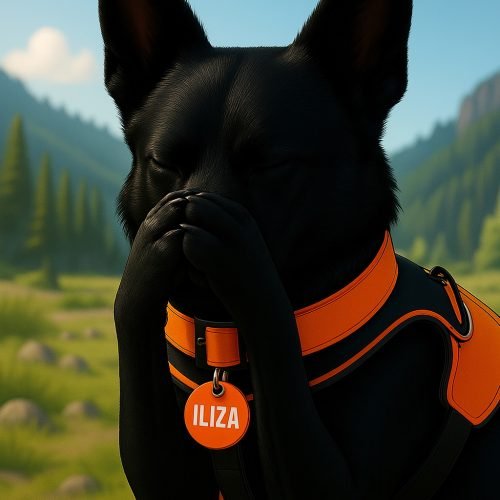
Conventional wisdom suggests Handler Discrimination (HD) is an advanced discipline, often introduced later in a dog’s training due to the complexity of human scent. But with my young pup, Iliza, I started HD at just 8 weeks old. Her success, and the elite performance of my older dog Kaja (one of only 92 dogs out of 28,454 in AKC Scent Work to achieve the Scent Work Master Handler Discrimination Elite (SHDME) title – less than 0.32%!), wasn’t magic. It was rooted in maximizing the “stink” factor of my personal scent, using a method I stumbled upon through pure experimentation, long before I understood the science.
This post will reveal the science behind potent handler scent and practical, unique methods to make your dog’s HD target unmistakable, demonstrating how you can achieve extraordinary results.
“Finding Me” Is Not An Easy Thing For A Dog To Do
It’s true: human scent is inherently far more complex and variable compared to the isolated, standardized essential oils (like Birch, Anise, Clove) used in scentwork trials. This complexity is why many find HD so challenging.
What most people, trainers or not, don’t realize is that human scent isn’t uniform. Our bodies have different kinds of sweat glands – apocrine and eccrine – that produce different kinds of sweat and, consequently, different “smells” when broken down by bacteria. Now before you say, okay Larry, this is already sounding too complex, let me explain. You don’t have to be a scientist to understand this, and I certainly didn’t understand any of this when I started training Handler Discrimination.
Many handlers use methods like simply wiping a cotton ball on their hands or arms, or for women, even placing it in a bra. While these transfer some scent, they often don’t create a strong or consistent enough scent picture for the dog because they aren’t leveraging the areas that produce the most potent odor. This leads to inconsistent alerts, dogs struggling to discriminate, false-alerts, or simply “checking out” of the search, leaving handlers frustrated and questioning their approach.
When I first started Kaja in scentwork, I didn’t even know what Handler Discrimination was. It wasn’t until later, seeing it in trials, that I thought, “That looks fun, let’s see if Kaja can find my odor!” I had minimal guidance, just my imagination on how to make my cotton glove and cotton ball really “stink,”‘ unaware of the scientific nuances.
My own simple scientific experiments, using agar plates (simple petri dish looking things you can buy from Amazon), visually confirm that items scented using apocrine gland areas, scientifically speaking, produce significantly more bacteria and thus, more odor. Make no mistake. I may have a Ph.D., but I am not a scientist. I don’t have near the intellect of a real scientist. Instead what I am, what I have always been, is naturally curious about how things work. In many ways, I’m still that annoying five year old that is always asking “why, but why?”
Think of training Handler Discrimination versus the essential oils used in scentwork/nosework like this: if essential oils are like a clear, single note on a piano, human scent is a complex symphony. Our goal in HD is to make your symphony so loud and clear that it cuts through all other background noise, becoming an unmistakable “jackpot” for your dog.
“Ooh-ooh that smell / Can’t you smell that smell?” Remember that great song by Lynyrd Skynrd? Just hum that song to yourself while I explain my philosophy on training Handler Discrimination.
In short it is this. My goal in training Handler Discrimination is to make my cotton glove or cotton balls so STINKY, that my dogs will have no problem finding me.
The Science of Your Scent: Apocrine vs. Eccrine Glands
Apocrine glands produce a thicker, protein-rich, oily sweat, found in armpits, scalp, and groin areas and can produce body odor when metabolized by bacteria. Eccrine glands, like those on the bottom of your feet, produce that watery sweat and are all over our bodies, and CAN contribute to foot odor when combined with bacteria.
You might be saying, “okay Larry, you’re losing me. I thought you were talking about Handler Discrimination and stink.”
And I am talking about “stink” and HOW you scent your cotton balls or cotton glove really matter. As gross as it may sound to us humans, we want lots of bacteria on our Handler Discrimination items, because that’s what will create the odor that our dogs can more easily smell. For the science part of this, sure, you can wipe your cotton balls or cotton glove across your body, or tuck those items in your bra like I know many women do, but if you really want to create a powerful stink, you should use the areas of your body that will produce a STINK POWERHOUSE, like the soles of your feet or under your armpits, where those nice warm, moisture rich environments will create significantly more odor than other areas of your body.
When I first started training Kaja for Handler Discrimination, my basic thought process was this: How can I scent my cotton ball so that Kaja can easily find it. Not knowing anything about glands or any of that scientific stuff, I did a simple experiment. I put a cotton ball on the bottom of my shoe and went out to mow the yard. While I was sweating like a pig in these hot, humid, Houston summers, I wiped the other cotton ball across my sweaty forehead and across my body.
Not knowing any better at the time, I came back inside and taped the cotton ball that was inside my shoe on the refrigerator door handle, and I taped the other pure sweat cotton ball on the underside of a table. I then grabbed Kaja, let her smell my hand, and told her to search. She searched around for a bit, walked right by the table with my sweat laden cotton ball, then went to the refrigerator door handle, sniff that cotton ball, and promptly ate it! Okay, so maybe my little experiment didn’t go exactly as planned (I should have used a cotton glove until she understood you’re not supposed to eat the cotton ball when you find it), but I still thought I had potentially discovered something useful when training Handler Discrimination.
My “Stink” Science Experiments: Visualizing the Invisible
We can’t “see” odor, but I was really curious if there might be a way for me to “see” if there were any differences based on how I scented my handler discrimination items. I felt that if I could “see” a difference in how a scented cotton ball or glove reacts to being scented in different areas of my body, then perhaps I could somewhat prove that how you really scent your HD items really could make a difference in how successful your dog could be in Handler Discrimination searches.
I searched on Amazon for petri dishes, and that led me to Agar plates, which certainly looked like petri dishes to me. So I ordered some for my experiments. Think of an agar plate (the clear, round dish you see in my photos) as a special dinner plate for tiny, invisible living things like bacteria and mold.
Inside that dish is a jelly-like substance called agar (which comes from seaweed). This agar holds a rich “meal called Luria Broth (LB), which is packed with all the nutrients these microbes love to eat. When you touch something to the agar – like my scented cotton balls – any bacteria or mold spores present get transferred onto their “dinner plate.”
For my first experiment, I used a brand new, clean cotton glove and touched it to the Agar plate (I wore latex gloves so as not to contaminate anything with my skin). I then took my scented cotton glove that I have been using for a couple of years, and touched that to a different agar plate. I labeled both plates, then stuck them in my garage where it was nice and dark and warm.

The above striking image shows a “Scented” plate teeming with microbial life next to a “Clean” control plate with virtually no growth.
But, what might happen if I did an experiment whereby I use just a cotton glove scented in my hand, versus one scented by rubbing it under my arms after a sweaty day?

You can see from the above two images, they both produced bacterial growth, but the plate from the “Under Arm” (left) shows a much higher density of growth, with many more colonies packed together and merging into larger patches. The “Left Hand” plate (right), while showing abundant individual colonies, has more separated growth and more visible agar. This visually demonstrates that the underarm, with its apocrine glands and ideal environment, fosters a significantly larger and more robust bacterial population compared to the hand. You may be wondering what that black growth thing is in the “Under Arm” plate. My speculation is it’s mold, because my under arm sweat was so sweaty.


While these plates don’t measure odor molecules directly, they powerfully illustrate why my method works. They show the sheer volume of odor-producing bacteria that thrive when conditions are optimized. And the ultimate proof? My dogs’ performance, like Kaja’s Master HD Elite, speaks for itself. Even Iliza, at just 15 months old, has already earned her UKC Novice Handler Discrimination (NHD) title, and is just one qualification away from earning her AKC Advanced Scentwork Handler Discrimination (SHDA) title.
The Game-Changer: My Unique Method for Maximizing Your “Stink” Factor (The Unconventional Discovery)
My method of using specific areas of my body to scent my cotton balls and glove wasn’t something I learned from a workshop or a textbook. It was an accidental discovery, born from simple trial-and-error with my own dogs, long before I understood the underlying science.
I’ve got another secret I’ll share with you that I use during Handler Discrimination searches. I’ve seen plenty of people at scentwork trials hold a baggie or glass jar with their cotton balls or gloves while waiting in line to begin their search. I’ve seen some handlers open their baggie or glass jar and let their dog smell those items to remind them what they are about to do. That is a great method to do before the search, and I do that as well.
My Little Secret
There is something else I do before a Handler Discrimination search, that I haven’t seen anyone else do, or perhaps they do, they just haven’t told anyone and are very secretive about it.
Before I begin an HD search, I take my baggie with my scented items, and I do all I can to heat that baggie up. And then ….
I breathe into the baggie and seal it
There’s science behind my madness. My breath isn’t just regular air, it contains all kinds of scent particles that are uniquely me. By breathing into my baggie, I’m giving Kaja and Iliza an extra dose of my personal scent. My warm breath supercharges the bacteria already on my cotton items, and at least theoretically, it’s producing odor more rapidly. Believe me, when I walk up to the steward for Handler Discrimination and open my baggie, even I can smell me, and I’m no dog!
The long gist of this post, is that I believe my method for achieving success in Handler Discrimination goes far beyond what seems to be the norm that others do. It’s entirely strategic on my part, and ultimately it was simply me trying to imagine what could help Kaja, and now Iliza, be successful in HD.
I can only assume that when we participate in Handler Discrimination that Kaja or Iliza starts sniffing, and they may detect the judges scented cotton item, or another competitors item, but my scented items are uniquely me, and the odor I’ve produced on them by targeting the glands on my body that produce more stench, makes it a compelling item for my dogs to find.
If I simply scented my items by holding them in my hand, or wiping them across my body, my dogs may be able to find me, but I want my odor to be as distinct as the scent of birch, or anise, or clove.
The methods I use for Handler Discrimination provide unmistakable clarity for my dogs, it reduces the guesswork that is required for them, and helps them gain confidence to be successful, even for a young dog like Iliza. My journey into the science of scent was entirely accidental. It was built on my predisposition to always ask why, and how.
Conclusion
Stop simply wiping a cotton ball and hoping for the best. Start thinking like a scent scientist – even an accidental one! – and truly maximize your “stink” factor. Your dog will thank you with clearer alerts, more confident searches, and a stronger bond.